
The 6 Blood Tests Your Cardiologist Should Order
The 6 Blood Tests Your Cardiologist
Should Order — But Probably Does Not
Your annual health check shows four numbers. There are six others that predict heart disease in Indians far more accurately. This page tells you exactly what to ask for, why it matters, and what dangerous levels look like. Print it. Take it to your next appointment.

The most important 5 minutes in your next doctor's appointment.
Most doctors order what is standard. Standard panels were designed for Western populations in the 1970s. They miss the four markers that specifically predict heart attacks in Indians — and two more that matter enormously for anyone already at risk. The good news: all six tests are available at any Indian diagnostic lab and cost between ₹500 and ₹800 each. The difficult part is knowing to ask for them.
This is not about second-guessing your doctor. It is about having a more complete conversation. Every one of the six tests below is referenced in the Lipid Association of India Consensus 2023 and supported by peer-reviewed research. If your doctor is thorough, they will agree when you ask. If they push back, ask why.
Test 1: hsCRP — Is There Active Fire in Your Arteries Right Now?
hsCRP is produced by the liver in response to inflammation anywhere in the body — including inside your arterial walls. When arteries are under active inflammatory attack, hsCRP rises — often years before you feel any symptoms. This single test tells you more about your immediate cardiac risk than your LDL number.
High-Sensitivity C-Reactive Protein (hsCRP)
Dangerous: above 3 mg/L — fourfold higher recurrent heart attack riskThe Indian Atherosclerosis Research Study found that Indians in the highest quartile of hsCRP had a fourfold higher risk of recurrent coronary events compared to those with low hsCRP. You can have perfectly controlled LDL — 70 mg/dL — and still have hsCRP of 6 mg/L, meaning your arteries are actively inflamed and your cardiac risk is four times higher than the numbers suggest. Cost at any diagnostic lab: approximately ₹400–600.
Test 2: Lp(a) — The Genetic Risk Your Lifestyle Cannot Change
This is the one most Indians have never heard of. And it is arguably the most important marker specifically for Indians. Lp(a) is genetically determined. Your diet does not control it. Your exercise routine does not control it. Standard statins barely affect it. But it is one of the most powerful predictors of early heart attack — and Indians carry significantly elevated levels compared to Western populations.
Lipoprotein(a) — Lp(a)
Dangerous: above 50 mg/dL — dramatically increases plaque formation and clotting riskLp(a) is highly sticky — it accelerates both plaque formation and blood clotting simultaneously. A PMC review of Indian cardiovascular data proposed Lp(a) deserves recognition as a major risk factor comparable to diabetes in Indians. Approximately 20% of all people globally have elevated Lp(a) — in Indians this percentage appears significantly higher. This test is not part of any standard panel in India. Asking for it specifically may be the single most important thing you do at your next appointment.
Test 3: ApoB — Counting the Actual Particles Entering Your Artery Walls
LDL-Cholesterol measures the weight of cholesterol in your blood. ApoB counts the number of LDL particles capable of depositing cholesterol in artery walls. These two numbers can point in completely different directions — you can have low LDL but high ApoB, meaning your particle count is dangerously high even though the weight measurement looks fine. This is extremely common in Indians.
Apolipoprotein B (ApoB)
Dangerous: above 100 mg/dL — above 80 if you are considered high-riskCARRS-NHANES data shows Indians have significantly higher ApoB than Americans despite showing comparable LDL numbers. A 2019 JAMA Cardiology analysis confirmed ApoB predicts cardiovascular risk significantly better than LDL alone. Every LDL, VLDL, IDL, and Lp(a) particle carries exactly one ApoB protein — so ApoB gives you the total number of atherogenic particles in your blood.
Test 4: Homocysteine — The Acid That Corrodes Your Artery Walls From Inside
Total Homocysteine
Dangerous: above 12 µmol/L — stroke and coronary heart disease risk increases significantlyElevated homocysteine directly damages the inner lining of arteries (endothelium), creating microscopic tears where plaque deposits begin. The primary cause in India: deficiency in B12, B6, and folate — estimated to affect 47% of the Indian population due to largely plant-based diets and gut absorption issues. This is one of the most preventable forms of cardiovascular damage — and one of the least tested for.
Test 5: Fasting Insulin — The Earliest Warning Sign — 10 Years Before Diabetes
Fasting Insulin
Dangerous: above 15 µIU/mL — indicates significant insulin resistanceInsulin resistance — where cells stop responding normally to insulin — directly drives visceral fat accumulation, fatty liver disease, and elevated LDL production. It precedes Type 2 diabetes by 10 to 20 years. And your fasting blood sugar can appear completely normal while insulin resistance is already significantly advanced. The ICMR-INDIAB study found Indians develop insulin resistance at lower body weights and earlier ages than Western populations. This test catches the problem a decade before your standard blood sugar does.
Test 6: GGT — The Liver Under Stress Long Before ALT and AST Catch It
Gamma-Glutamyl Transferase (GGT)
Dangerous: above 55 U/L (men) or above 38 U/L (women)GGT rises when the liver is under oxidative stress — often long before the standard liver enzymes (ALT, AST) show any abnormality. Elevated GGT is an independent predictor of cardiovascular disease, metabolic syndrome, and all-cause mortality. Since the liver produces approximately 80% of LDL cholesterol, a stressed liver showing elevated GGT is a direct cardiovascular warning sign. Think of GGT as an early warning system for the Yakrit Dushti that Charaka identified as the root cause of heart disease.
Not sure which of these tests apply to your situation?
Our team can help you understand which tests matter most for you — free WhatsApp consultation
You now know the 6 tests. Clear Heaart addresses every marker they measure.
hsCRP elevation is addressed by Ashwagandha and Ginger. Lp(a) driven platelet risk is addressed by Arjuna. Liver stress shown in GGT is addressed by Kutki and Pippali. Insulin resistance is addressed by Methi and Cinnamon. Every test in this guide has an ingredient in Clear Heaart targeting that exact pathway.
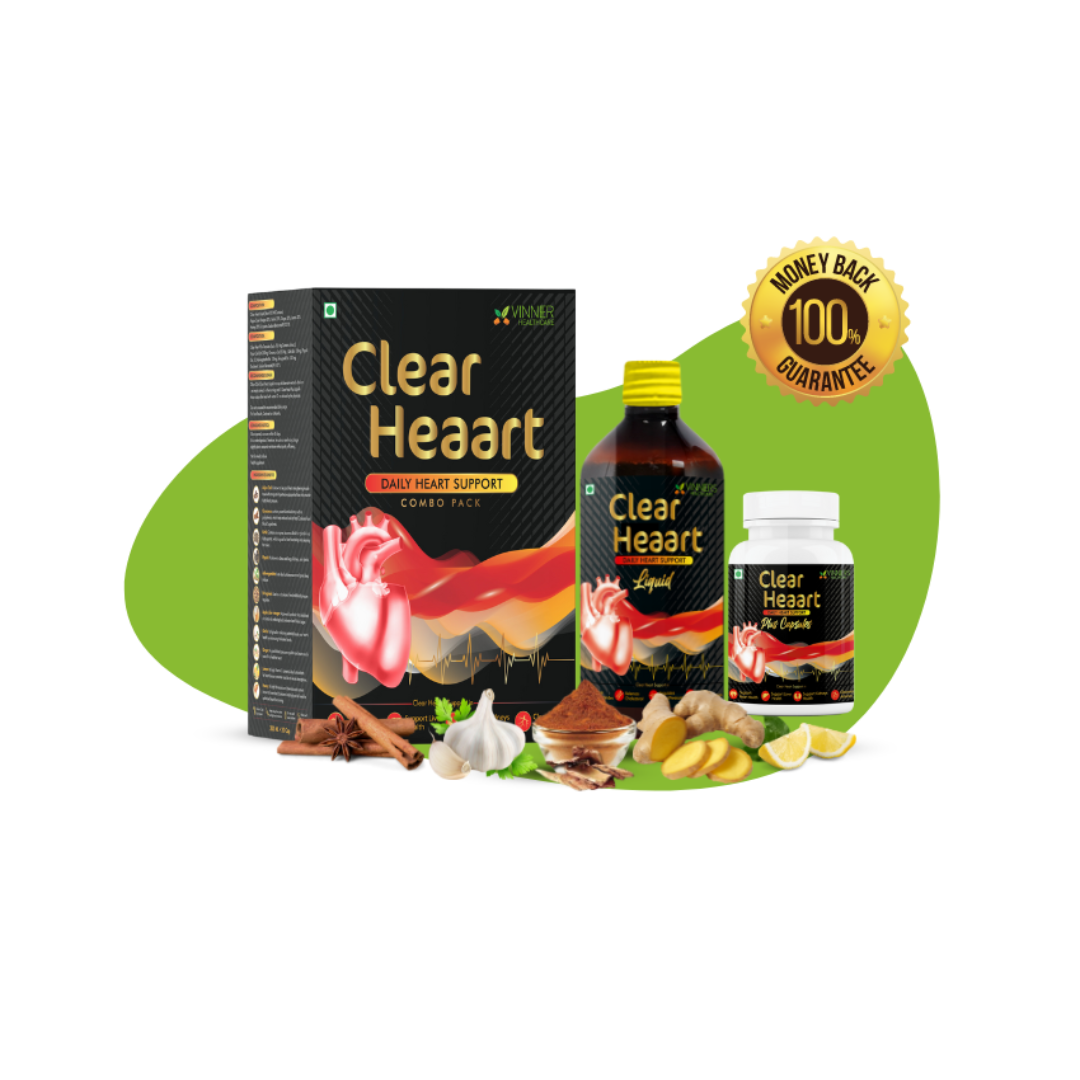
India's First Ayurvedic Formula That Works at Every Stage of Heart Blockage
11 clinically-proven Ayurvedic ingredients addressing the 3 root causes — liver dysfunction, arterial inflammation, and platelet clotting — from Stage 1 through Stage 4.
Safe alongside your existing medication
Clear Heaart is safe to take alongside statins, beta-blockers, and antihypertensives. The Khalil 2005 study confirmed that Arjuna bark combined with statins produced additive benefit — not interference. Always inform your doctor when starting any new supplement.
See Which Ingredient Addresses Each Test Result
Each of the 6 markers above has one or more Clear Heaart ingredients specifically targeting that pathway — with a clinical trial confirming it.


