
charaka ct report
What Charaka Would Say About
Your Cardiac CT Report
Your report says soft non-calcified plaque in LAD. Charaka would have said Mridu Ama in Hridaya Srotas. Same diagnosis. Same urgency. 2,400 years apart. Here is the complete translation.

His calcium score was 0. His cardiologist said nothing to worry about.
Calcium score 0 does not mean no plaque. It means no calcified plaque yet. Soft, non-calcified plaque — the kind that ruptures and causes heart attacks — shows no calcium score. This is one of the most dangerous misunderstandings in cardiac care. Charaka had a precise term for this stage: Mridu Ama. Soft, unformed, fully treatable — and the most important time to act.
Most people receive a cardiac CT report and understand about 30% of what it says. This blog translates every major CT finding into the clinical language Charaka used 2,400 years ago — because both languages are describing exactly the same thing happening inside your body. Understanding it is the first step toward doing something about it.
CT Finding: Soft Non-Calcified Plaque — Charaka's Term: Mridu Ama
Soft Non-Calcified Plaque in LAD
Early-stage fatty deposits inside arterial walls that have not yet calcified. Associated with higher rupture risk than calcified plaque. Calcium score: 0. This is Stage 1–2 blockage — the most reversible stage. Most people are falsely reassured at this point.
Mridu Ama in Hridaya Srotas
Mridu (soft) Ama (undigested metabolic waste) in the Hridaya Srotas (heart channels). Charaka considered this the most treatable stage. The Srotas are still open. The Ama has not yet hardened. Arjuna bark and Kutki specifically prescribed. The message in both languages: this is your window. Use it.
CT Finding: Ejection Fraction Below 50% — Charaka's Term: Hridaya Bala Kshaya
Reduced Left Ventricular Ejection Fraction
Normal is 55–70%. Below 50% means the heart muscle is not contracting with full force — often the result of prior ischaemia or chronic inflammation. Symptoms: fatigue, breathlessness on exertion.
Hridaya Bala Kshaya — Depletion of Cardiac Force
Reduction of Hridaya Bala (cardiac force). Primary remedy: Arjunaksheerapaka. In the Bharani et al. RCT (1995), Arjuna bark improved ejection fraction from 42% to 52% in post-MI patients within 3 months. Charaka described the condition and prescribed the treatment 2,400 years before the clinical trial confirmed it.
CT Finding: Calcium Score Rising — Charaka's Term: Pakva Ama
Coronary Artery Calcium (CAC) Score Rising
Score 1–100: mild. 100–400: moderate risk. 400+: severe. A rising calcium score tells you how long the blockage process has been running. Calcified plaque is harder to reverse — but the process can still be slowed significantly.
Pakva Ama — Hardened, Long-Deposited Metabolic Residue
Pakva (cooked, hardened) Ama. Charaka distinguished this from Mridu (soft) Ama — Pakva required more intensive Shodhana protocols and longer treatment timelines. The distinction between soft and calcified plaque, and different treatment approaches for each stage, was documented 2,400 years ago.
Ultrasound Finding: Fatty Liver — Charaka Says: Treat This First
When a cardiac CT shows concerning findings and an ultrasound also shows fatty liver — now extremely common in Indian patients — modern cardiology treats them as two separate conditions managed by two separate departments. Charaka would have treated the liver first, every time. Because the liver (Yakrit) is the source of the metabolic waste (Ama) damaging the heart. Fix the source. The downstream problem resolves.
What Stage You Are At — and What to Expect from Clear Heaart
TimelineClear Heaart addresses every stage. Earlier is better. Every stage improves.
"Your CT report is a snapshot of what has been happening in your liver for the last 10 years. Fix the liver now — and the next CT will tell a different story."
— Vinner Healthcare Research, based on Charaka Samhita Yakrit Chikitsa and AHA Cardio-Renal-Hepatic Axis 2024
Have a recent CT report you want to understand?
Our team can help interpret it and explain what Clear Heaart addresses — free WhatsApp consultation
Whatever your CT report says — this is your next step.
Mridu Ama or Pakva Ama. Stage 1 or Stage 4. Clear Heaart's 11 ingredients work at every level of blockage progression — with different timelines but a consistent direction. Earlier is better. Now is better than later.
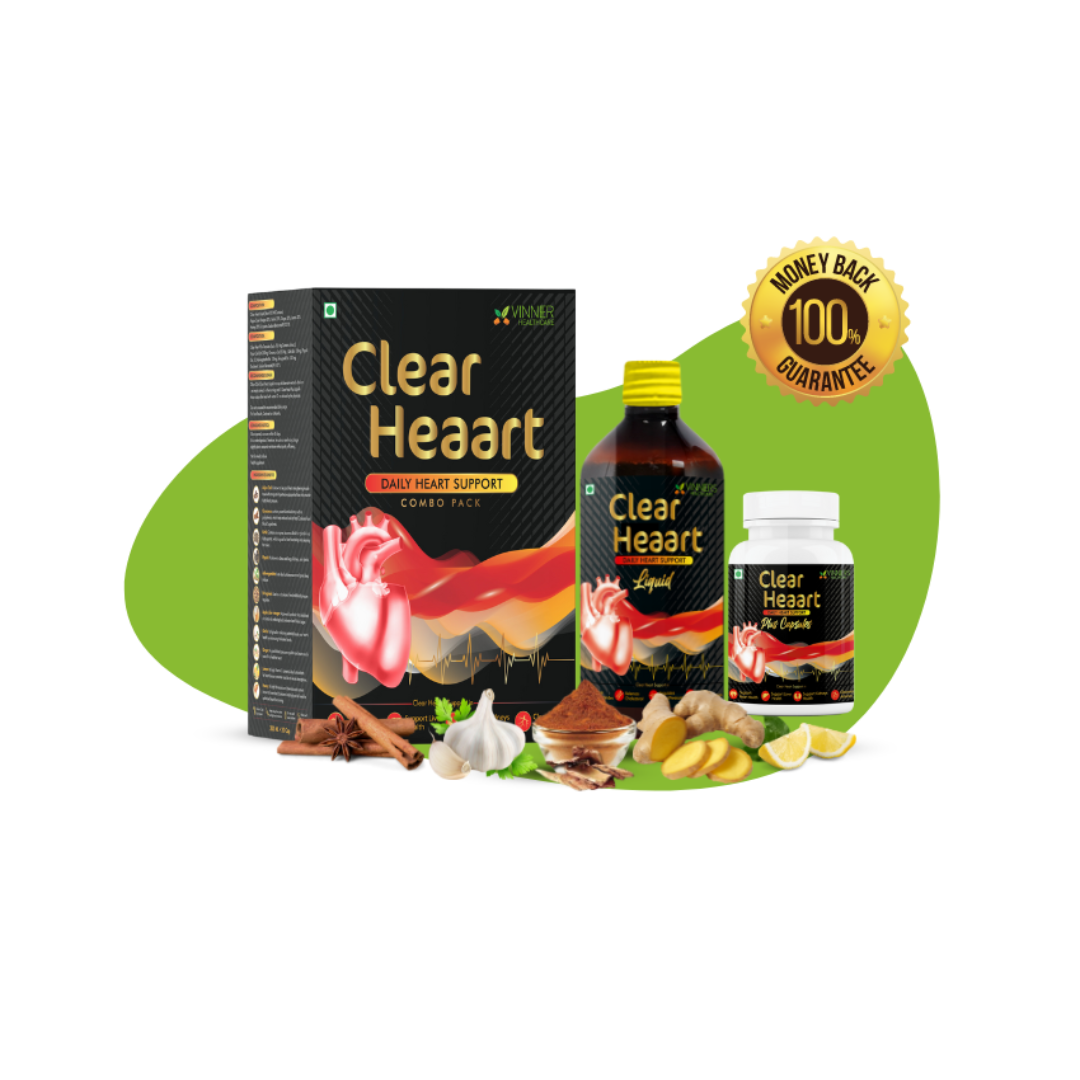
India's First Ayurvedic Formula That Works at Every Stage of Heart Blockage
11 clinically-proven Ayurvedic ingredients addressing the 3 root causes — liver dysfunction, arterial inflammation, and platelet clotting — from Stage 1 through Stage 4.
Safe alongside your existing medication
Clear Heaart is safe to take alongside statins, beta-blockers, and antihypertensives. The Khalil 2005 study confirmed that Arjuna bark combined with statins produced additive benefit — not interference. Always inform your doctor when starting any new supplement.
See the Formula That Works at Every Stage of What Your CT Found
11 ingredients. 11 clinical trials. Every mechanism your CT report is indirectly describing — addressed at its root.


