
LDL Hidden Markers

He was 38. His annual test was 'perfectly normal.'
His LDL was 96. His HDL was 48. His doctor said everything was fine. Eight months later he had a heart attack. What nobody tested: his Lp(a) was 84 mg/dL — nearly double the danger threshold. This is not a rare story. In India, 40% of high-risk patients are completely missed by standard LDL testing.
The standard lipid panel was designed for Western populations in the 1970s. It measures the weight of cholesterol in your blood. But it is not the weight that causes heart attacks — it is the number of particles, their stickiness, and the inflammation they trigger. Four hidden markers reveal all of this. Your standard test reveals none of it.
Prediction Power — Standard Test vs Advanced Markers
How accurately each predicts a heart attack in IndiansSource: JAMA Cardiology · Indian Atherosclerosis Research Study · Lipid Association of India 2023
Marker 1 — ApoB: Counting the Actual Bullets, Not Just the Gun Powder
Most people think heart disease is caused by 'high cholesterol.' The truth is more precise: it is caused by LDL particles that enter artery walls and deposit there. LDL-Cholesterol measures how much cholesterol is floating in your blood. ApoB counts how many particles are actually capable of entering your artery walls. You can have 'normal' LDL and still have enormous numbers of dangerous ApoB particles circulating.
ApoB — Apolipoprotein B
Dangerous: above 100 mg/dL (above 80 if you are high-risk)Every single LDL, VLDL, IDL, and Lp(a) particle carries exactly one ApoB protein. So counting ApoB tells you the exact number of atherogenic particles in your blood — which is what actually drives blockage. A 2019 JAMA Cardiology analysis confirmed ApoB predicts cardiovascular risk significantly better than LDL alone. CARRS-NHANES data shows Indians have higher ApoB than Americans despite comparable LDL numbers.
Marker 2 — Lp(a): The Genetic Risk Your Lifestyle Cannot Fix
This is the one that surprises people most. Lp(a) is a genetically determined form of LDL. Your diet does not control it. Your exercise routine does not control it. Standard statins barely affect it. It is written into your DNA. And Indians as a population carry significantly elevated Lp(a) levels compared to Western populations.
Lp(a) — Lipoprotein(a)
Dangerous: above 50 mg/dLLp(a) is highly sticky — it accelerates both plaque formation and blood clotting simultaneously. A PMC review of Indian cardiovascular data proposed that Lp(a) deserves recognition as a major risk factor comparable to diabetes in Indians. The Indian Atherosclerosis Research Study confirmed that Indians with elevated Lp(a) had dramatically higher rates of recurrent cardiac events. Yet this test is not part of any standard panel in India.
"Lp(a) may be the most underrecognised cardiovascular risk factor in Indians. It is genetic, it is dangerous, and it is completely invisible on a standard lipid panel."
— PMC6796644, Indian Atherosclerosis Research Study
Your LDL test may be hiding serious risk
Ask us which tests you actually need — free consultation on WhatsApp
Marker 3 — hsCRP: Is There Fire Burning in Your Arteries Right Now?
Heart attacks are not simply caused by plaque building up. They happen when inflamed plaque ruptures. hsCRP (high-sensitivity C-Reactive Protein) measures active inflammation in your body — including inside your arterial walls. When hsCRP is elevated, your arteries are under attack. Often for years before you feel anything.
hsCRP — High-Sensitivity C-Reactive Protein
Dangerous: above 3 mg/L — fourfold higher recurrent heart attack riskThe Indian Atherosclerosis Research Study found that Indians in the highest quartile of hsCRP had a fourfold higher risk of recurrent coronary events. You can have perfectly controlled LDL and still have an hsCRP of 6 mg/L — meaning your arteries are actively inflamed and your risk of a cardiac event is four times higher than someone with low inflammation. This test costs less than ₹500 at any diagnostic lab.
Marker 4 — Homocysteine: The Amino Acid That Corrodes Arteries From the Inside
Homocysteine is produced naturally by the body when processing proteins. In normal amounts it is harmless. When it builds up — due to B12, B6, or folate deficiency — it directly damages the inner lining of your arteries. It creates microscopic tears. Those tears are where plaque deposits begin. This deficiency is endemic in India due to largely vegetarian diets and gut absorption issues.
Homocysteine
Dangerous: above 12 µmol/L — stroke and CHD risk increases significantlyThe Multi-Ethnic Study of Atherosclerosis confirmed that elevated homocysteine is associated with increased coronary heart disease and stroke risk independent of other risk factors. B12 deficiency — the primary driver of high homocysteine — affects an estimated 47% of the Indian population. This is one of the most preventable forms of cardiovascular damage. And almost nobody is testing for it.
What to tell your doctor at your next appointment.
Ask specifically for: ApoB, Lp(a), hsCRP, and Homocysteine — in addition to your standard lipid panel. If your doctor is thorough, they will agree immediately. These four tests together cost ₹2,000 to ₹5,000. The information they give you is worth far more.

These 4 markers are exactly what Clear Heaart was built to address.
ApoB excess, Lp(a) driven inflammation, hsCRP arterial fire, homocysteine vessel damage — each of these pathways has a specific ingredient in the Clear Heaart formula targeting it with a published clinical trial.
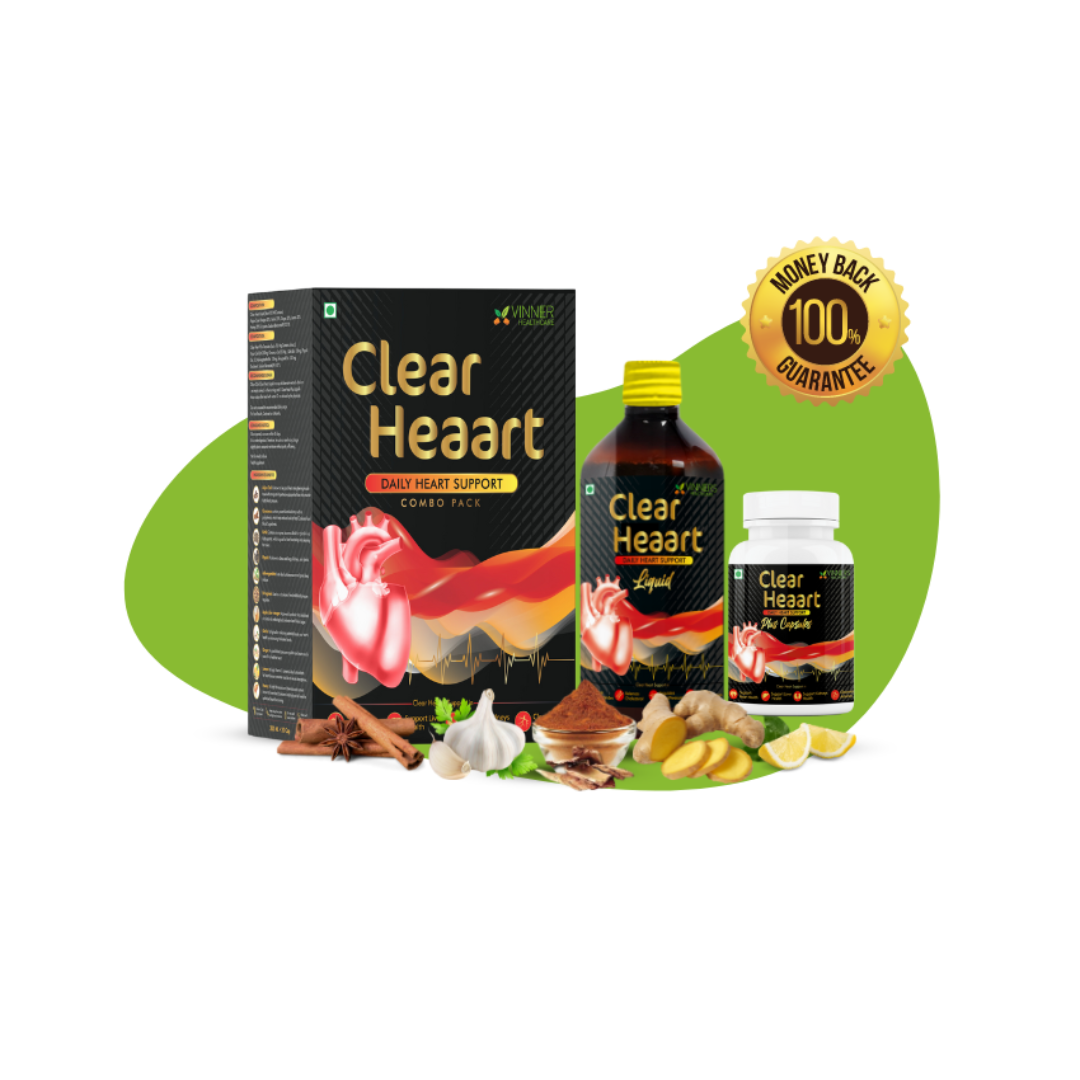
India's First Ayurvedic Formula That Works at Every Stage of Heart Blockage
11 clinically-proven Ayurvedic ingredients addressing the 3 root causes — liver dysfunction, arterial inflammation, and platelet clotting — from Stage 1 through Stage 4.
Safe alongside your existing medication
Clear Heaart is safe to take alongside statins, beta-blockers, and antihypertensives. The Khalil 2005 study confirmed that Arjuna bark combined with statins produced additive benefit — not interference. Always inform your doctor when starting any new supplement.
Clear Heaart Works Where Standard Tests Stop Measuring
See which of the 11 ingredients addresses each hidden risk marker — and the clinical trial behind each one.


